
Smart Sauna Features in 2026
A backyard sauna has always been a straightforward proposition: heat, cedar, and time. But in 2026, the technology layer around that core experience has matured considerably — and for Alberta homeowners planning a new KOTA, HAVN, or OASE build, it's worth understanding what's available and what actually improves the experience versus what's noise.

Smart Heater Controls: What They Actually Do
The most meaningful technology upgrade available in a modern outdoor sauna is a smart-connected heater controller. The principle is simple: instead of walking out to the sauna twenty to forty minutes early and manually starting the heater, you schedule the session from your phone. By the time you're ready to use it, the sauna is already at temperature.
The best systems including controllers from Harvia and HUUM, both well-regarded in the Canadian market go beyond simple scheduling. Harvia's Fenix controller, for example, uses adaptive logic that learns how your specific sauna heats up based on its insulation quality, interior volume, and ambient temperature. You set a target ready time and the system calculates the optimal start moment. On an Edmonton January evening when the exterior temperature is sitting at -20°C, that adaptive calculation matters: a sauna with thick insulation heats differently than one without, and a system that accounts for that delivers a more consistent experience.
By 2026, app-based control has become standard on most mid- and high-end sauna heaters. It's no longer a premium feature it's what you should expect from a quality build.

Lighting: The Most Underinvested Feature in Most Saunas
Lighting is where the gap between a sauna that feels good and one that feels exceptional is most often found — and it's frequently where budget gets trimmed at the wrong moment.
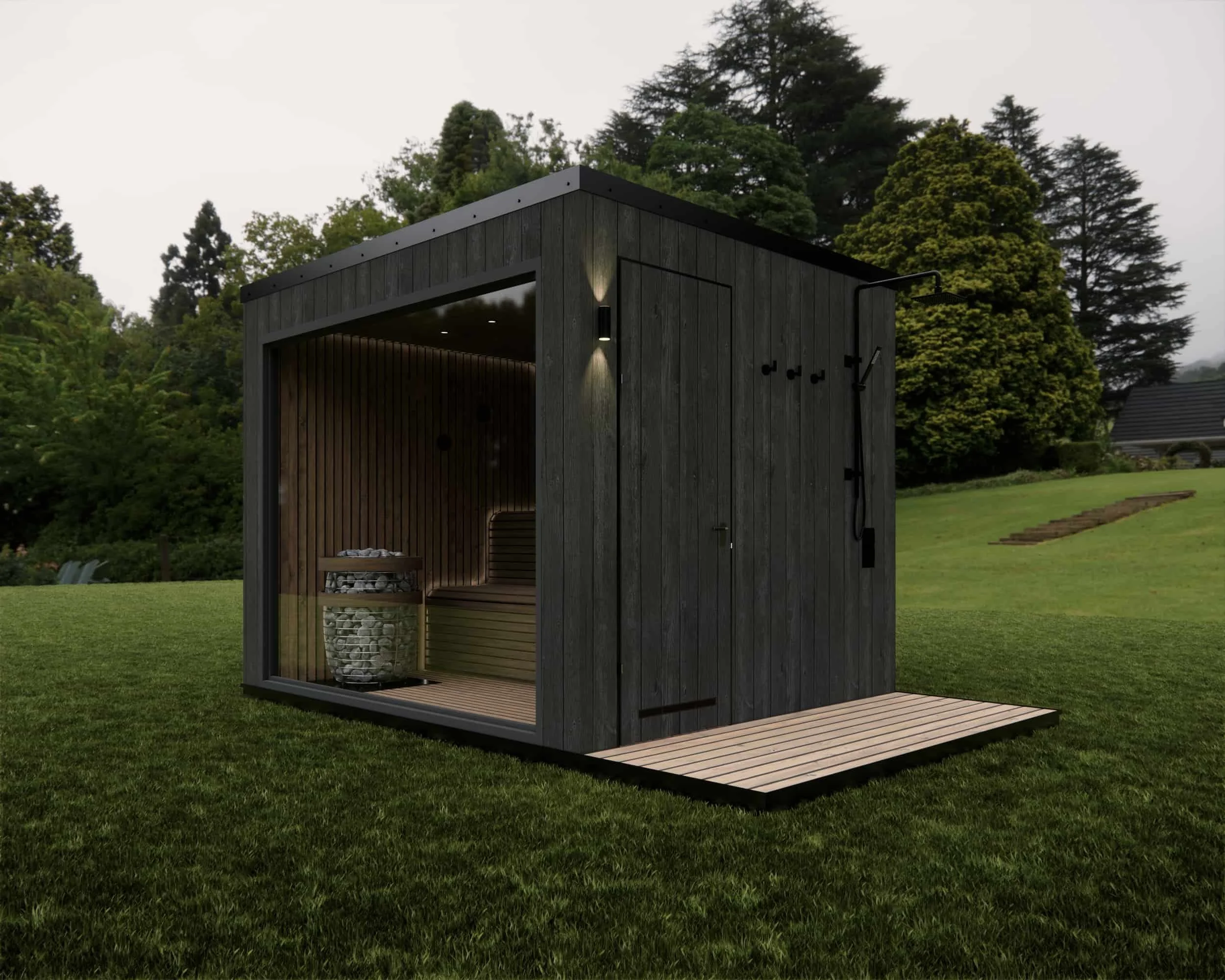
The functional case for layered sauna lighting is straightforward. Harsh overhead lighting works against relaxation. Warm-toned, low-level light from LED strips along bench edges, recessed fixtures in the ceiling, and exterior accent lighting on the structure's outside walls creates the environment that makes a sauna genuinely useful as a recovery and wind-down space.
Beyond mood, exterior lighting on the sauna structure itself serves a practical purpose in Alberta winters: it makes the path from the house to the sauna navigable and visually inviting in the dark, which is often the only time busy homeowners can use it on a weeknight.
Furda Builds structures are designed with lighting integration in mind. For clients who want a complete setup, we can advise on interior fixture placement and exterior lighting options that complement the cedar and roofline of each build.
Heater Types: Getting the Basics Right Before Adding Technology
Smart controls are only as good as the heater underneath them. Before committing to a technology package, it's worth understanding the two main heater types and what each delivers in Alberta's climate.
Electric heaters are the standard choice for residential outdoor saunas in Canada — they're clean, controllable, and compatible with smart control systems. They heat consistently regardless of outside temperature, which matters in a climate where January nights can drop well below -30°C in Edmonton and Calgary.
Wood-fired heaters offer the most traditional experience and have no ongoing electricity cost once installed. The heat they produce has a quality — softer and more radiant — that many experienced sauna users prefer. The trade-off is that they require active management, a properly installed chimney, and a reliable wood supply. They're also less compatible with remote scheduling for obvious reasons.
For most Alberta homeowners building a KOTA or HAVN sauna for daily or near-daily use, a quality electric heater with smart control is the practical choice. For those who want the traditional experience and use the sauna less frequently, wood-fired is worth the consideration.
What to Ask About When Planning Your Build
If smart sauna features are a priority for your Furda Builds project, the conversation to have during the planning phase covers three things: heater brand and control system compatibility, wiring and wifi access to the structure's location in your yard, and lighting placement within the interior and exterior of the build.
The electrical requirement for an outdoor sauna in Alberta typically means a dedicated 240V circuit run to the structure. This is a standard part of the permitting and installation process, but it's a detail to confirm early — particularly if your electrical panel needs an upgrade to accommodate it.
Your Backyard Has More Potential Than You Think!
The KOTA, HAVN, and OASE from Furda Builds are all compatible with quality electric heater and control systems. If you're planning a build for fall installation and want to talk through the smart feature options, reach out. We'd rather have that conversation at the design stage than after the structure is already in place.
Ready to build something worth walking to? Explore the Verk at furdabuilds.ca or reach out to Furda Builds to start the conversation — serving Edmonton, Calgary, Sherwood Park, and St. Albert.

Sources:
American Psychological Association — Physical boundaries and cognitive performance
University of California Irvine — The Cost of Interrupted Work
Journal of Clinical Sleep Medicine — Natural light, alertness, and cognitive functioning
Environmental psychology research on workspace separation and mental clarity
